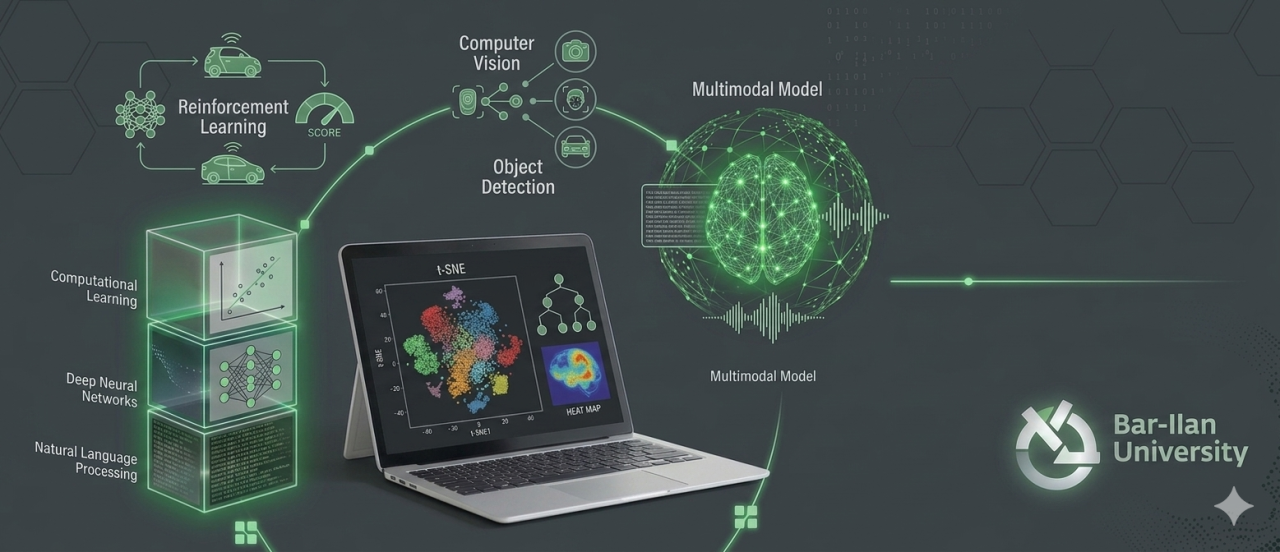


Who Will Invent and Build the Next Generation of AI Systems?
Introducing a new Bachelor's degree in Computational Artificial Intelligence at the Department of Computer Science and Artificial Intelligence at Bar-Ilan University—for students who aspire not only to use AI, but to build the intelligent systems that will shape the future.
Artificial intelligence is already transforming the way we work, learn, conduct research, and make decisions. Yet behind every AI application that appears simple at first lies a sophisticated ecosystem of algorithms, data, computational models, and—most importantly—the expertise of the people who design, train, evaluate, and continuously improve these systems.
Today, the critical question is no longer simply who will know how to use AI tools. The real question is who will understand how they work, how they can be improved, where their limitations lie, and how to develop them responsibly.
In other words: Who will build the AI systems of tomorrow?
This question inspired the creation of Bar-Ilan University's new B.Sc. in Computational Artificial Intelligence - a program designed for outstanding students who want to explore AI at its deepest levels from the very beginning of their academic journey. Rather than becoming advanced users of AI technologies, students learn to design, develop, and advance the technologies themselves.
An AI Degree - Not Just an AI Specialization
The B.Sc. in Computational Artificial Intelligence is dedicated to the development and scientific foundations of artificial intelligence. Rather than serving as a specialization within a traditional Computer Science degree, the program is a standalone undergraduate degree, specifically designed around the rapidly evolving field of AI.
The curriculum features a distinct academic structure, 18 newly developed AI-focused courses, and instruction by internationally recognized faculty members. From the first year onward, students build a deep understanding of intelligent systems while acquiring the knowledge required to develop advanced AI models.
The program is founded on a simple principle: learning to use AI is insufficient. Students must understand the computational foundations that make modern AI possible—from mathematics and theoretical computer science to low-level programming, GPU programming, complex systems, robotics, Large Language Models (LLMs), and hands-on development of real-world AI applications.
Throughout the program, students develop a comprehensive toolkit that combines scientific rigor, software engineering expertise, systems thinking, and extensive practical experience with state-of-the-art AI technologies.
Eighteen Dedicated AI Courses
The curriculum includes 18 newly developed courses that extend well beyond the traditional Computer Science curriculum. Students are introduced to the core technologies underlying modern AI systems from the very beginning of their studies.
The curriculum includes:
- Low-level programming of computer hardware, beginning in the first year of studies
- Foundational AI courses starting in the first semester
- GPU programming and advanced machine learning systems during the second and third years of the degree
- AI agents and AI-driven robotics in the third year
- Building Large Language Models (LLMs) from first principles as an advanced elective
- Mathematics and theoretical foundations specifically tailored to AI
- Hands-on projects involving real-world AI systems
The distinction is fundamental: students do not study AI from the outside—they learn how the engine itself is built.
Why Now? Because Using AI Is Insufficient
Artificial intelligence has rapidly become an essential component of virtually every industry, including high-tech, healthcare, finance, cybersecurity, education, manufacturing, and public services. Organizations increasingly rely on AI to automate workflows, analyze data, generate software, identify patterns, and support complex decision-making.
As AI systems become deeply integrated into technological infrastructure, the demand for professionals who intimately understand these systems continues to grow. Industry increasingly requires engineers capable not only of deploying AI technologies, but also of designing, improving, and extending them.
At the same time, entry-level software engineering has changed dramatically. Tasks that in the past were assigned to junior engineers such as routine programming, software testing, and basic development - are becoming increasingly automated. As a result, graduates who possess deep computational understanding, systems-level thinking, and genuine expertise in artificial intelligence are becoming significantly more valuable.
Recognizing this shift, Bar-Ilan University's new program combines rigorous scientific foundations with practical engineering skills, systems-level understanding of AI, and awareness of the societal implications of intelligent technologies from the very beginning of undergraduate education.
Technological Excellence with Human Responsibility
Artificial intelligence is far more than a technological discipline. It is transforming economies, societies, and everyday life. Consequently, AI developers must address not only algorithms and software, but also broader questions involving responsibility, fairness, bias, privacy, trust, and societal impact.
The Computational Artificial Intelligence program reflects this perspective through a uniquely interdisciplinary approach. Alongside advanced technical training, students complete a required course on Society, Ethics, and Technology in the Age of Artificial Intelligence.
The course examines the ethical, social, and human dimensions of AI, encouraging students to critically evaluate the broader consequences of the technologies they create.
This commitment forms a defining characteristic of the program: educating graduates who combine advanced technical capabilities with research-oriented thinking and a deep understanding of the human impact of intelligent systems.
Academic Leadership
The program is led by Professor Gal Kaminka, Head of the Computational Artificial Intelligence Program and founder of Bar-Ilan University's Robotics Laboratory.
Professor Kaminka is an internationally recognized researcher in artificial intelligence, robotics, and multi-robot systems. He completed his academic training at the University of Southern California (USC) and Carnegie Mellon University, and is among the very few Israeli researchers elected Fellow of both the Association for the Advancement of Artificial Intelligence (AAAI) and the European Association for Artificial Intelligence (EurAI). A recipient of the prestigious Landau Prize for Excellence in Research, he combines internationally recognized academic leadership with entrepreneurial and industrial experience in advanced AI technologies.
For students, this means learning under the guidance of a leading AI researcher whose expertise bridges cutting-edge scientific research with practical development of AI and robotic systems.
The program is offered by Bar-Ilan University's Department of Computer Science and Artificial Intelligence, home to one of Israel's oldest and strongest AI research communities. The department includes approximately fifteen internationally recognized AI researchers, including two AAAI Fellows (out of only six in Israel) and three EurAI Fellows (out of only eight nationwide).
The department's research excellence is also reflected in international rankings. According to CSRankings, Bar-Ilan University ranks first in Israel in Natural Language Processing (NLP) for the period 1986–2026—a field central to the development of Large Language Models and advanced AI systems such as ChatGPT.
In addition, Bar-Ilan ranks first in Israel in Computer Security, an increasingly critical discipline as intelligent systems, data infrastructures, and digital technologies become foundational to modern society and industry.
Are Similar Undergraduate Programs Available Worldwide?
Dedicated undergraduate degrees in Artificial Intelligence remain relatively new within higher education. In recent years, leading institutions—including Carnegie Mellon University and the University of California, San Diego (UC San Diego)—have begun establishing independent AI degree programs.
Bar-Ilan University joins this emerging global movement with a program whose identity is centered entirely on Artificial Intelligence. From the first day of study, students focus on understanding, developing, and advancing AI systems.
Rather than encountering AI as a later specialization or an elective concentration within Computer Science, students enroll in a degree program designed around AI as its central academic and scientific discipline.
Why Choose a B.Sc. in Computational Artificial Intelligence?
Choosing this degree means more than selecting a new academic program—it means positioning yourself at the forefront of one of the most transformative fields shaping the technological, scientific, and societal landscape of the coming decades.
The program integrates rigorous scientific foundations with deep computational understanding, advanced problem-solving, technological innovation, critical thinking, and responsible AI development.
As Artificial Intelligence becomes increasingly embedded across industries and research domains, demand continues to grow for professionals who understand how intelligent systems are designed—not simply how to use them.
Graduates of the program will enter the workforce with a distinct advantage: specialized undergraduate education in AI that remains rare both in Israel and internationally. Rather than adding AI as a specialization later in their studies, they will receive a comprehensive education built around AI from day one.
Who Is This Program Designed For?
The program is intended for outstanding students with strong quantitative and technological aptitude, intellectual curiosity, analytical thinking, and a commitment to academic excellence.
The curriculum is rigorous and demanding, making it particularly well suited for students who aspire to lead the field of Artificial Intelligence rather than simply work alongside it.
Admission requirements include:
- A Psychometric Entrance Test score of 700 or higher
- Advanced high school mathematics qualifications
Graduates will be well prepared for careers in the high-tech industry, advanced AI development, and academic research, supported by an education that combines deep scientific foundations with practical expertise in developing the technologies that will define the coming decade.
The future of Artificial Intelligence will not be shaped solely by those who use today's tools—but by those who understand them deeply and build the next generation of intelligent systems.