


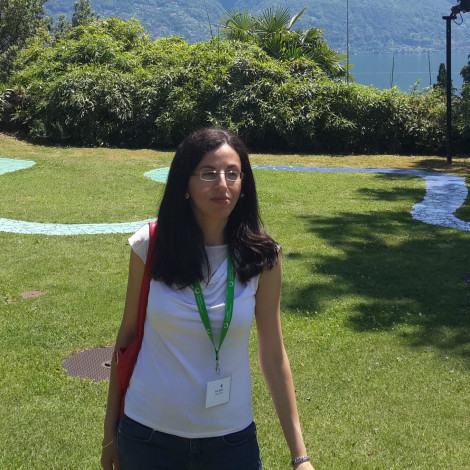
Prof. Esther Ezra
Computational Geometry, Discrete Geometry, Polynomial Techniques, Geometric Approximation Algorithms, Proximity, Randomness in Computation, Geometric Discrepancy
CV
Prof. Ezra completed her Ph.D. at Tel Aviv University under the supervision of Prof. Micha Sharir, one of the world's leading figures in computational geometry. She later pursued postdoctoral fellowships at Duke University, and New York University, and later was an assistant Professor at Georgia Institute of Technology, before joining the faculty at Bar-Ilan University. She is a recipient of the ISF grant for her research on geometric arrangements and algebraic methods in geometry, she is a recipient of the BSF grant for her research on range search, and was previously awarded the NSF CAREER grant for her work on geometric discrepancy . Her work is regularly published in top-tier venues, including SoCG, FOCS, STOC, and SODA.
Research
Computational Geometry and Geometric Algorithms
An autonomous vehicle navigating an urban environment must decipher its surroundings in real time: identifying pedestrians, traffic signs, and obstacles, and calculating a collision-free path. This is the heart of Computational Geometry—the challenge of representing objects in space, calculating distances and overlaps, and making critical decisions in real time.
Prof. Esther Ezra develops the algorithmic infrastructure for solving complex geometric problems. Her research focuses on analyzing spatial structures, partitioning spaces into simpler regions, and providing rapid responses to location and optimization queries within massive datasets.
The central pillar of her work is "The Algebraic Method" - applying the polynomial method in order to decompose complex geometric scenes into units that can be analyzed efficiently. This approach provides advanced methods for geometric incidences, range searching, and nearest neighbor search.
Primary Research Areas:
Computational & Discrete Geometry
Geometric Approximation Algorithms
Algebraic Methods in Geometry
Randomized Algorithms
Research Nature:
Theoretical-Applied: Developing mathematical proofs and efficient algorithms for solving complex geometric problems.
Career Path:
Graduates of the lab acquire advanced skills in algorithmic problem-solving and spatial data analysis, transitioning into high-impact roles:
Industry: Algorithm development in computer vision, robotics, mapping, and graphics.
Autonomous Systems: Developing navigation solutions, drone technology, and spatial data analysis for defense and civilian sectors.
Academia: Research and faculty positions at leading global institutions.
Last Updated Date : 29/07/2026